
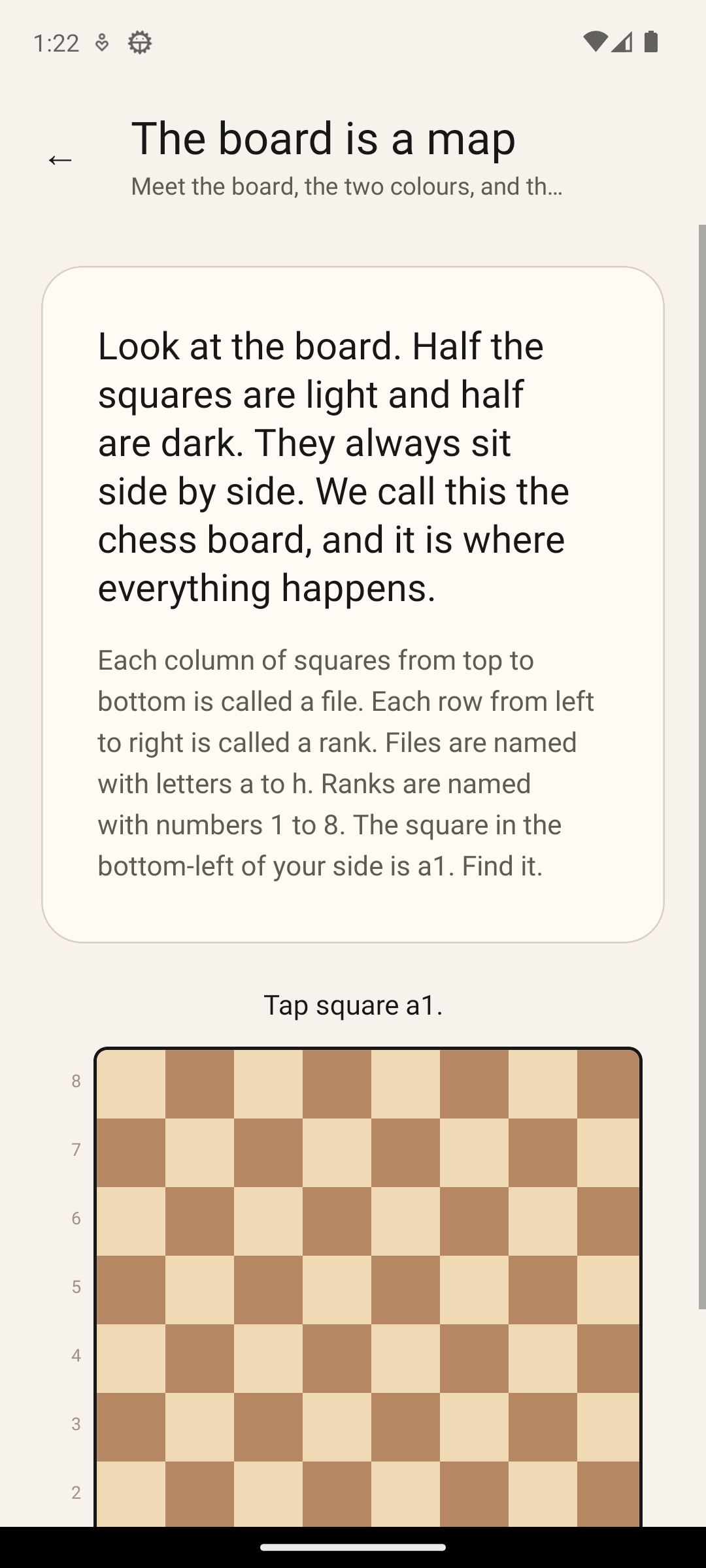
Lesson
Teaching that stays close to the boardPlain language, short instruction, and the board sitting right under the explanation.
A calm, offline-first chess app for children and beginners. Clear instruction, guided puzzles, on-device progress, and a real graduation point that prepares learners for play beyond the app.

Guided puzzles and practice positions that keep lessons active instead of passive.
Foundations is the current release. The full path grows from 30 structured beginner sessions to a 90-session curriculum.
Bundled launch languages in the Android release: English, Spanish, and French.
Real screens from the current build. No staged marketing renders.
Plain language, short instruction, and the board sitting right under the explanation.
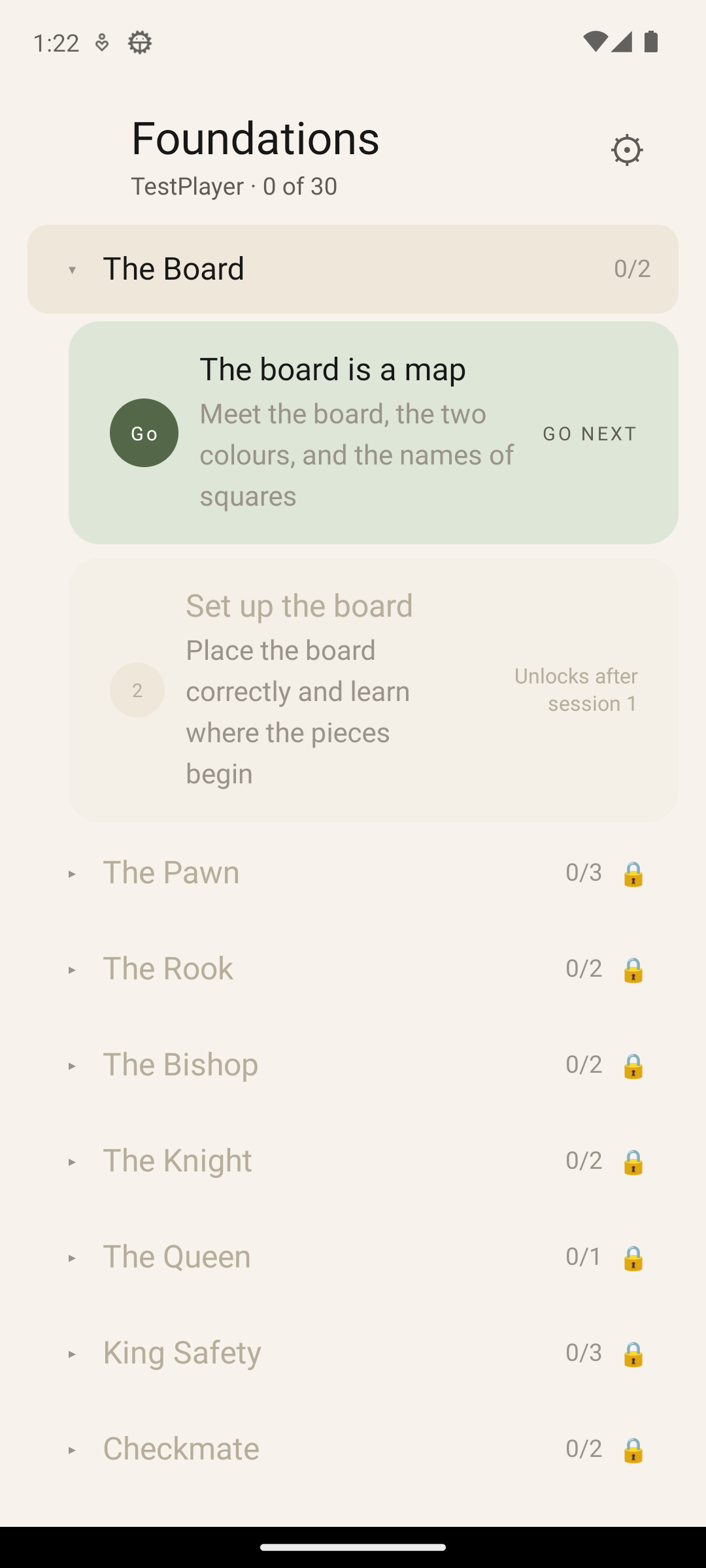
Families and coaches can see order, scope, and a finish line.
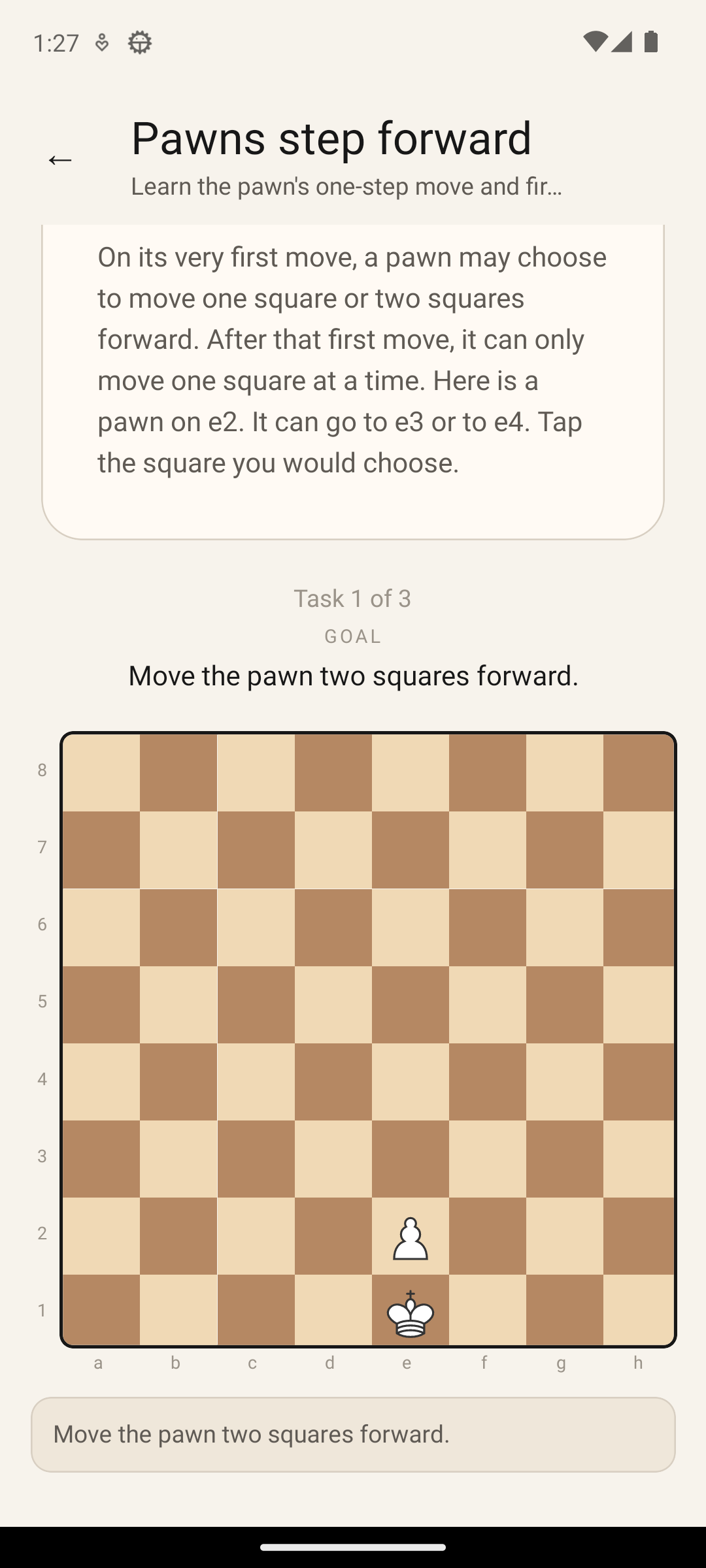
The learner keeps applying each rule instead of only reading about it once.
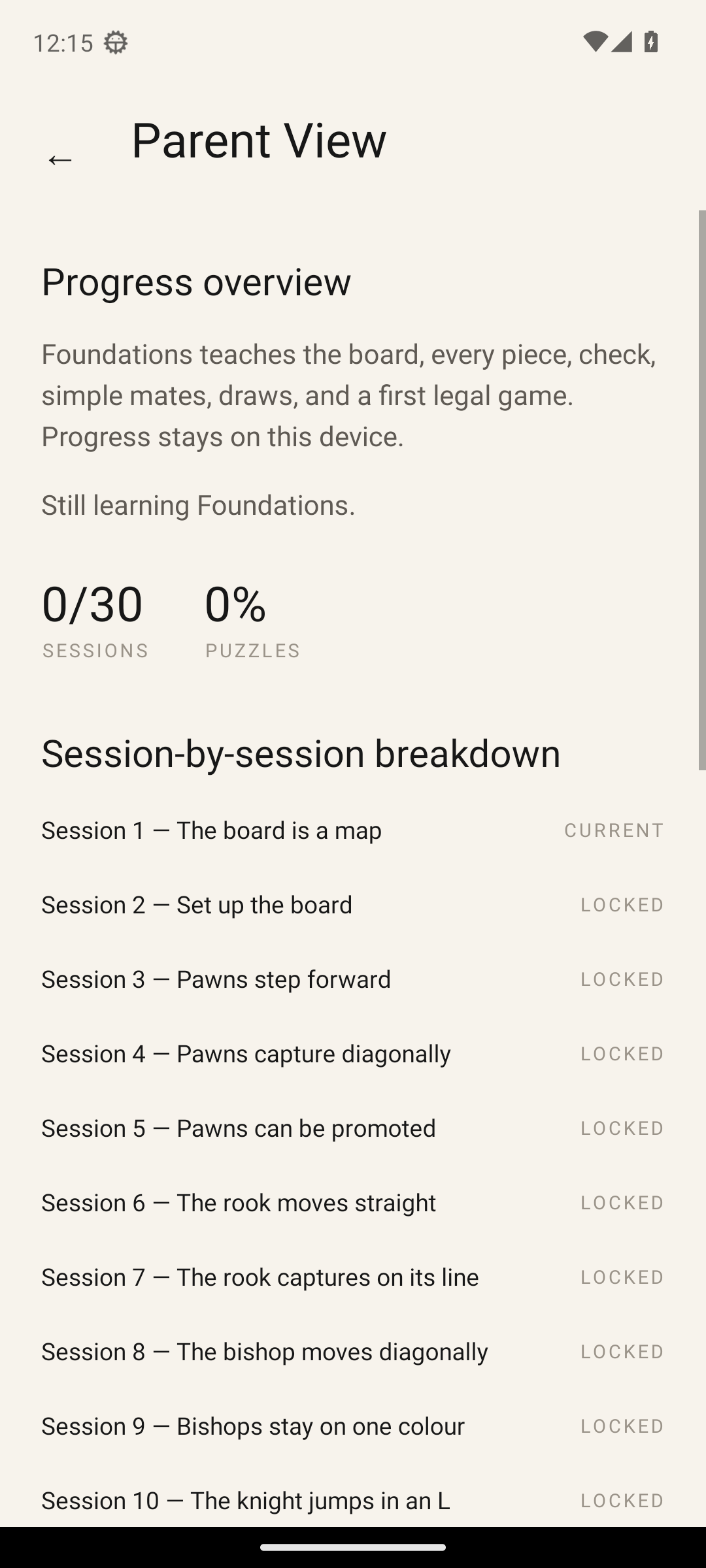
Progress review stays on the device. A decision parents understand quickly.
Most chess apps for children try to keep them inside forever. ChessGraduation is built to teach the rules properly, reinforce them with puzzles, and hand the learner off to real play.
Clear instruction, puzzle reinforcement, and a real finish line.
No streaks, countdowns, chat loops, or reward-loop pressure.
The app prepares the learner for clubs, coaches, and the wider chess world.
A calm first chess app you do not need to supervise. Ten minutes on the kitchen table, no ads, no chat, no accounts. The product teaches; the parent does not have to become a co-instructor.


The lesson order is concrete enough to assess before buying. Foundations runs across 30 structured sessions, with puzzle reinforcement at every step.
QR progress sharing replaces dashboards. The app runs offline, which is what after-school programmes and rural classrooms actually need.
Quiet product decisions matter more than loud marketing claims.
Zero network requests at runtime. Learning progress stored locally on the device.
Foundations covers 30 structured sessions, guided puzzles, and first full games.
Full app planned at €19.99. Foundations is €9.99 during development.
Designed to hand the learner off when ready for clubs, coaches, and broader platforms.
It is the first chess app I have shown a beginner where the next step is always obvious and the noise is always absent.Coach voice · Beginner programme
Core rules, legal play, first full games, and puzzle-backed reinforcement across 30 sessions.
Notation, clock handling, deeper tactics, and stronger practical decisions.
Certificate on device, practical next-step guidance, and a respectful handoff to clubs or major platforms.
Foundations teaches legal play in 30 sessions. Matchplay is the planned continuation toward confident club and tournament play.
30 sessions · beginner track
Sessions 31–90 · planned continuation
Learners move from knowing the rules to choosing useful first moves: claim the centre, develop pieces, castle safely, and avoid early queen adventures.
Centre control, development, and castling demonstrated in games.
Forks introduce tactical vision: one move can create two threats. The goal is to spot loose pieces and overloaded defenders before moving.
Learner solves 80% of fork puzzles.
Pins and skewers teach line pressure. Learners practise seeing when a rook, bishop, or queen makes a piece unable to move safely.
Learner solves 80% of pin/skewer puzzles.
These sessions slow the game down to essential endings. The learner practises the two clean mating methods they are most likely to need first.
K+Q vs K and K+R vs K checkmates.
Notation turns a played game into something the learner can review. The focus is simple reading and writing, not tournament bureaucracy.
Learner transcribes a 10-move game correctly.
The learner meets practical tournament habits: using a clock calmly, touching pieces carefully, recording results, and behaving well at the board.
Learner completes a timed practice game.
Mixed tactics combine forks, pins, skewers, mate threats, and material choices so the learner stops solving by category and starts reading the board.
Learner solves 80% of the Matchplay puzzle set.
Longer games against a stronger local opponent test decision-making without online pressure. The learner practises opening habits, tactics, and endgames together.
Learner wins 3 games against Intermediate AI.
The final block checks readiness, prepares the graduation handoff, and points the family toward clubs, coaches, and broader chess platforms.
Learner meets the final graduation conditions.
No subscriptions. The product graduates the learner; the relationship is finite by design.
30 structured sessions, guided puzzles, progress tracking, and a certificate at the first milestone.
The full app once Matchplay is complete: deeper puzzle sets, stronger practical play, and the full graduation route.
One-time pricing matches the graduation promise: parents pay once, the product does its job, and the relationship does not depend on ongoing pressure.
For coaches and clubs — ask about licences →
Short reading on beginner chess learning, offline trust, and when a learner is ready to move beyond the app.
Short answers to the questions families and coaches ask first.
Private by default, offline-first, and honest about scope. Pay once, learn properly, then move on to real play.
